

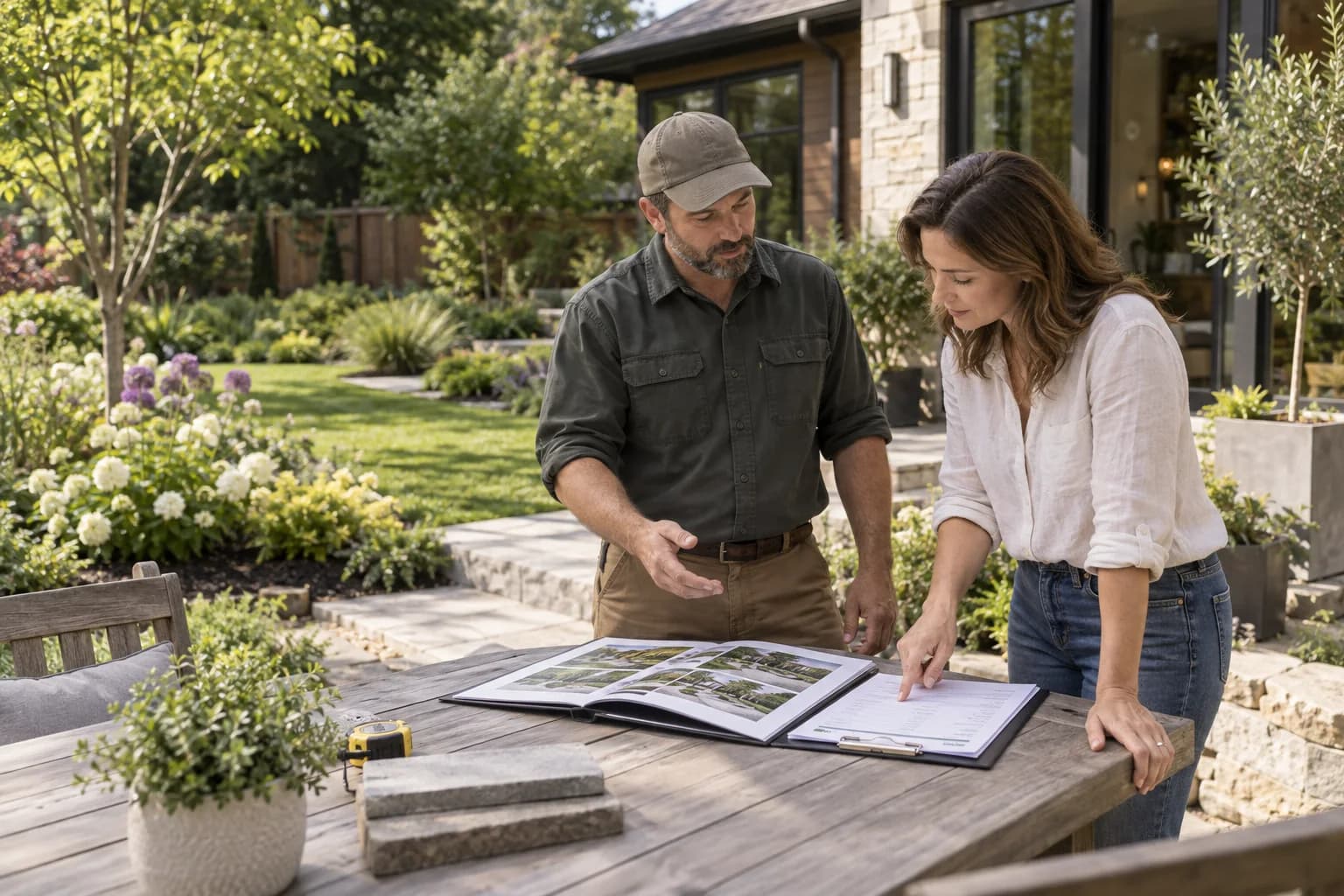
A good landscaper can turn a rough idea into an outdoor space that drains properly, fits the way you live, and improves as the planting matures. A poor fit can leave you with failed plants, uneven paving, surprise charges, or a yard that stays unfinished for weeks.
You cannot judge that difference from a company name or a five-star average. The useful evidence is in the details: who priced the work, who will build it, what the price includes, and what happens when the site or schedule changes. Use this guide as an interview sheet and keep notes as you speak to each company.
1. Start by Defining Your Landscaping Project
Before asking companies for a price, write a one-page brief. It does not need to be a finished design. It does need to tell every bidder what problem you want solved, what must stay, and where you are flexible.
Question 1: What exactly do we want this project to achieve?
- Outcome: more usable seating, safer steps, better drainage, lower maintenance, privacy, play space, pollinator planting, or a complete redesign.
- Scope: the areas included, what stays, what goes, and any work you plan to do yourself.
- Constraints: access width, slopes, pets, mature trees, underground services, neighborhood rules, parking, and working hours.
- Budget: a realistic range, with your must-haves separated from features you could add later. Keep a contingency outside the quoted scope for genuinely unforeseen conditions.
- Timing: a genuine deadline, preferred planting season, and dates when the property must remain usable.
Take the same photos and measurements to every site visit. If one company prices a simple patio while another assumes new drainage, lighting, and mature planting, their totals tell you very little.
2. Landscaper vs. Landscape Designer: Who Do You Need?
“Landscaper” can describe maintenance, planting, construction, or a company that manages all three. A landscape designer typically develops the layout, material palette, and planting plan, although the title and scope are not regulated everywhere. A landscape architect is a regulated professional in many jurisdictions and may be appropriate where grading, public safety, complex drainage, permitting, or substantial structures are involved.
Question 2: Does this project need design, construction, specialist advice—or a combination?
A small bed refresh may only need an experienced planting crew. A full yard with retaining walls, level changes, drainage, a pool, or protected trees may need a designer, engineer, arborist, electrician, irrigation specialist, or licensed landscape architect. Ask who is responsible for each decision and whether design fees are included in the construction price.
Professional titles and permitted scopes vary by location. For example, the American Society of Landscape Architects explains that US states regulate landscape architecture through different title or practice rules. Verify the requirements where the property is located instead of relying on a title printed on a website.
3. Check Experience With Similar Projects
Ten years mowing lawns does not prove experience building a retaining wall. Likewise, beautiful estate gardens do not show that a company is the right fit for a compact urban yard with access through the house.
Question 3: Which completed projects are genuinely comparable to ours?
Ask for examples that match at least two or three of your project’s defining features: budget range, size, slope, access, climate, materials, drainage problem, or planting style. Then ask what proved difficult, what changed after work began, and how the company handled it. Three relevant examples tell you more than a gallery of unrelated gardens.
If your job includes a specialist element, ask about that element directly: “How many segmental retaining walls of this height did your team build last year?” is stronger than “Do you do hardscaping?”
4. Ask to See Recent Landscaping Projects
A portfolio should help you inspect workmanship, not just decide whether you like the style. Request recent, completed projects and make sure the company you are interviewing actually designed or built the parts being shown.
Question 4: Can you show us work completed by the team that would handle our project?
- Ask when the work was completed and which parts the company performed.
- Look at edges, joints, steps, grading, transitions, drainage outlets, and finish around fences or buildings—not only the wide “after” shot.
- For planting, ask for images after one or two growing seasons. Freshly installed plants can hide poor spacing or unsuitable selections.
- Where appropriate and with the former client’s permission, ask whether you can view a completed project from the street or during an arranged visit.
If practical, ask to see an in-progress site. You can learn a great deal from how the crew protects the property, stores materials, manages mud and dust, and leaves the site at the end of the day.
5. Check Reviews and References
Reviews are useful for spotting patterns, but an average score cannot tell you whether the reviewer hired the company for a two-hour cleanup or a four-month build.
Question 5: What do recent clients say about work like ours?
Read the newest positive, mixed, and negative reviews rather than only the most prominent ones. Look for repeated comments about communication, punctuality, change orders, site care, and how the company responded when something went wrong. A calm, specific response to criticism can be more informative than dozens of generic compliments.
Ask for two or three recent references, ideally including one project completed at least a year ago. With the client’s permission, ask:
- Did the final price and scope match the agreement?
- Who supervised the work, and was that person available?
- How were delays, changes, or defects handled?
- Did drainage, paving, irrigation, and planting perform as expected?
- Would you hire the same company again?
6. Ask About Insurance, Licenses, and Local Requirements
A logo on a van is not proof of coverage or authorization. Requirements can change with the jurisdiction and the work itself: general landscaping, pesticide application, irrigation connections, electrical work, tree work, engineered walls, and hauling may each be treated differently.
Question 6: What insurance, licenses, registrations, permits, or certified trades apply to this exact scope?
- Ask for current proof of liability insurance and check that the named business, coverage dates, and type of work match the proposal.
- Ask about workers’ compensation or the local equivalent where employees or subcontractors will be on site.
- Verify relevant license or registration numbers with the issuing authority, rather than relying on a screenshot supplied by the contractor.
- Confirm who will obtain permits, arrange inspections, locate utilities, and pay the fees.
- For specialist work, verify the individual or subcontractor who will actually perform it.
7. Understand What Is Included in the Quote
A price is only comparable when the work behind it is visible. A line that says “Landscape backyard: $18,000” does not tell you what you are buying—or what may be charged later.
Question 7: Can you walk us through every inclusion, allowance, assumption, and exclusion?
A useful landscaping quote should identify:
- site preparation, demolition, excavation, grading, and protection;
- measured quantities and specifications for materials and plants;
- labor, expected crew, equipment, delivery, disposal, and daily and final cleanup;
- drainage, irrigation, lighting, electrical, or utility responsibilities;
- design work, permits, inspections, taxes, and third-party fees;
- allowances for undecided products and the price basis behind them;
- restoration of lawns, paving, fences, or access routes disturbed by the work;
- the process for pricing and approving a change before it is carried out.
Ask whether you have received a fixed quote or an estimate that may change, and how long the price remains valid. Then test the scope with a real scenario: “If excavation reveals buried concrete, what happens next?” The answer should point to a written change-order process with a price and schedule impact agreed before the extra work begins.
8. Ask Who Will Actually Perform the Work
The polished estimator may not return once the contract is signed. That is not necessarily a problem, but you should know who will make decisions on site.
Question 8: Who will supervise the project each day, and which parts will be subcontracted?
Ask for the site lead’s name and experience, the expected crew size, and how often the designer or project manager will visit. For subcontractors, ask who selects them, who checks their insurance and credentials, and whether you pay them or the main contractor. The contract should identify who is responsible for their work, scheduling, and payment.
Agree on one person who can approve changes on your behalf and one person who can approve them for the company. A quick conversation beside the excavator should not quietly become a four-figure variation.
9. Discuss Materials and Plant Selection
Two proposals can look identical while allowing very different products. “Stone patio” might mean thin slabs on an unspecified base or a carefully specified system designed for the local soil and freeze-thaw conditions.
Question 9: Which exact materials and plants are priced, and what happens if they are unavailable?
- For hardscape, record product names, dimensions, colors, finish, base depth and material, edge restraints, jointing material, and drainage approach.
- For plants, request botanical names, quantities, container or trunk sizes, and an agreed substitution process.
- Ask why the plants suit the site’s light, soil, moisture, climate, mature size, and maintenance level.
- Confirm who waters and cares for new planting, how long establishment takes, and which failures a plant warranty excludes.
Do not leave a phrase such as “or similar” open-ended. Define who decides what counts as equivalent, how a substitution will be approved, and whether a cheaper product reduces the contract price.
10. Confirm the Project Timeline
A start date is not a complete schedule. Weather, plant availability, permits, inspections, and other jobs can all affect landscaping work, so ask for a realistic plan rather than a promise that assumes everything goes perfectly.
Question 10: What is the expected start window, duration, work sequence, and delay process?
The written schedule should cover major stages, decisions you must make, long-lead materials, inspection points, normal working days, and any period when the yard, driveway, water, or power will be unavailable. Ask how the company communicates weather delays, whether the crew will remain assigned to your job, and how other projects could affect the sequence.
If you need the garden for a fixed event, say so before pricing. A credible company may recommend changing the scope, phasing the work, or moving the date rather than promising an unsafe or rushed finish.
11. Understand Payments, Deposits, and Warranties
Payment terms should fund a sensible progression of work without leaving either party dangerously exposed.
Question 11: What triggers each payment, and what protection remains after completion?
Ask for a written deposit and milestone schedule tied to work you can identify—such as material delivery or completion of a defined phase—rather than dates alone. Before releasing a milestone payment, walk through the completed phase and record any agreed corrections. Keep receipts and pay the contracting business through a traceable method. Avoid paying the full price in advance. Deposit limits, cancellation rights, and rules concerning final payment vary by jurisdiction, so check local consumer rules before signing.
Separate the warranties in writing: workmanship, hardscape products, irrigation equipment, and living plants may all have different terms. Record the duration, what is covered, exclusions, maintenance you must perform, how to make a claim, and how quickly the company will inspect a reported problem. Ask whether the installer or the manufacturer handles product claims. A warranty is only useful if you know who stands behind it and what could void it.
12. Compare Multiple Landscaping Companies
Meeting several companies is not about forcing the price down. It helps you see different approaches, identify missing scope, and judge whether a proposal is unusually vague or optimistic.
Question 12: Which company offers the strongest complete plan for our priorities and risk—not simply the lowest total?
Give each company the same brief, then compare the final written proposals on a single page:
| Compare | What to record | Why it matters |
|---|---|---|
| Scope | Quantities, preparation, inclusions, exclusions, allowances | Reveals whether the totals cover the same result |
| Capability | Comparable work, site lead, specialists, references | Connects the sales promise to the people doing the work |
| Risk | Insurance, local credentials, permits, change process | Shows how foreseeable problems will be managed |
| Delivery | Start window, duration, crew availability, communication | Tests whether the plan is practical |
| Value | Materials, design quality, price, payment schedule, warranties | Balances upfront cost with durability and aftercare |
A higher quote may include better preparation, larger plants, disposal, permit support, or a more experienced crew. A lower quote may be perfectly sound, but first find out whether anything is missing. Ask each bidder to explain the differences and correct any omissions in writing before you choose.
13. Red Flags to Watch For
Pause the process if a landscaping contractor:
- pressures you to sign immediately or offers a price that expires that day;
- appears uninvited and claims to have leftover materials from a nearby job;
- will not provide a business address, written scope, or verifiable references;
- asks for the full price—or an unexplained large cash payment—before work begins;
- wants payment to an unrelated individual or refuses to give receipts;
- dismisses permits, utility locating, drainage, or insurance as unnecessary without checking;
- uses only generic portfolio images or cannot explain their role in the projects shown;
- promises a precise schedule before surveying access and site conditions;
- will not document changes to scope, price, or timing;
- provides credentials or insurance details that cannot be verified.
One missing document may be an honest oversight. A pattern of urgency, vague answers, unverifiable claims, and untraceable payment is a reason to walk away. The FTC’s home improvement scam guidance similarly recommends multiple written estimates, a reviewed contract, verified licensing and insurance, and no full payment upfront.
14. Find Landscapers Near You
Start your search with the project, not the phrase “best landscaping company near me.” Decide whether you need planting, lawn work, hardscaping, irrigation, drainage, tree care, design, or a team that can coordinate several specialties. Then shortlist businesses whose published work and services match that need.
Use the Greendexo landscaper map to browse local landscaping businesses across the US, Canada, and the UK. Open company profiles to compare declared services, coverage areas, and project photos, then send the same brief to the strongest matches and request a site visit and written proposal.
Greendexo is a directory, not the contractor on your project. Listings and project profiles are a starting point for comparison, not an endorsement. Verify insurance, licenses or certifications, permits, references, pricing, availability, warranties, and suitability directly with the business and the relevant local authority before hiring.
Sources and editorial notes
This guide was reviewed on September 24, 2026. It applies general consumer-protection principles to landscaping projects; it is not legal, insurance, engineering, or horticultural advice. Requirements and consumer rights vary by location and scope. The primary references used were: