

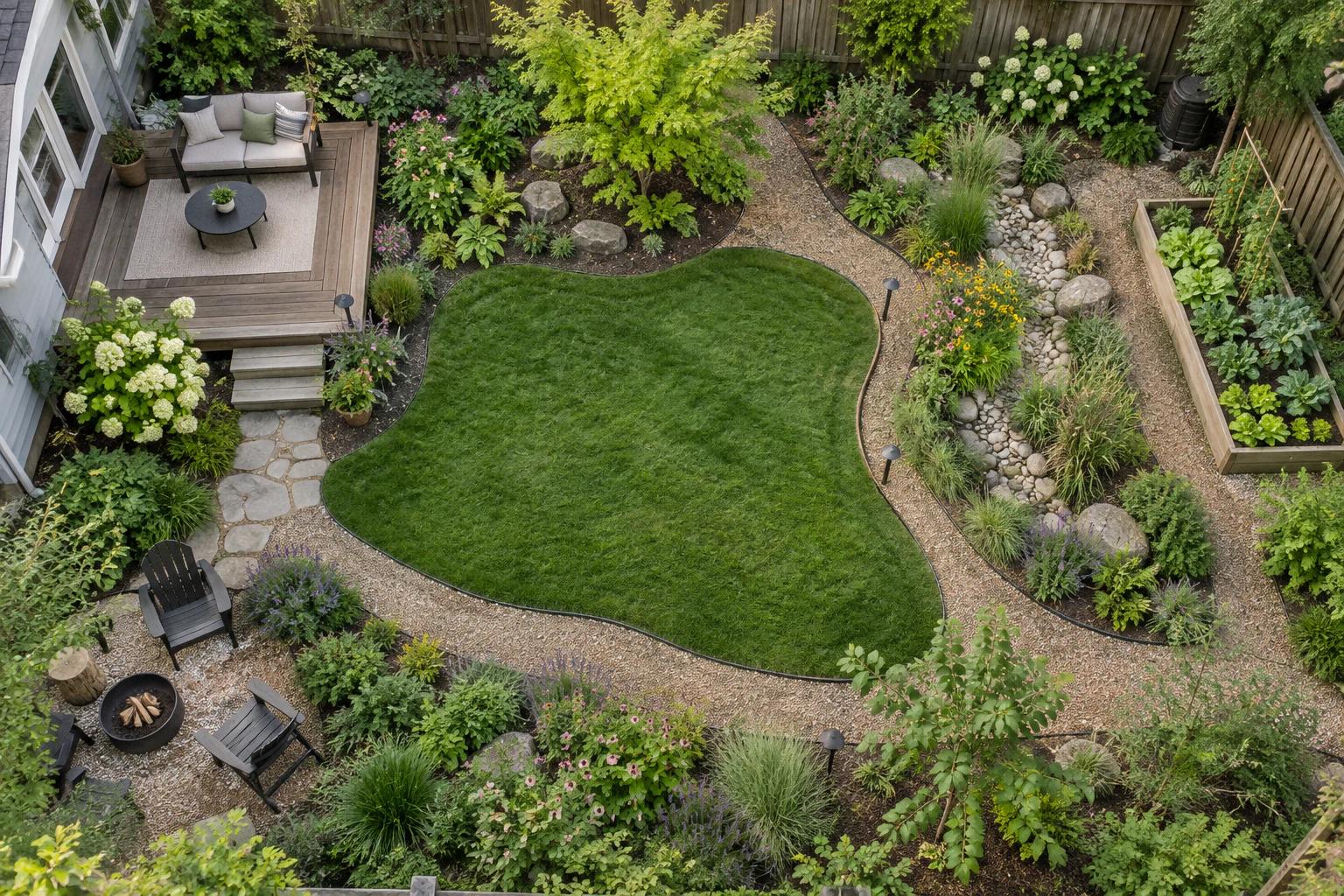
A good landscape is not simply photogenic. It makes everyday life outside easier: there is somewhere comfortable to sit, a dry route to the gate, privacy where you want it, and planting you can realistically look after. Start with the irritation you notice every time you step outdoors. It is often the clearest clue to what should change first.
The 25 ideas below range from a focused weekend improvement to a complete backyard makeover. The budget groupings refer to the likely scope of the work, not a promised price. Access, ground conditions, plant sizes, materials, labor, and local requirements can make the same project straightforward in one yard and complex in another.
1. Before You Start: Define Your Goals and Budget
Before choosing plants or paving, decide what the yard needs to do. Is it a place for weekday dinners, a safer route from the driveway, room for children or a dog, more privacy, better drainage, a pollinator garden, or simply less weekend maintenance? Put the answers in order. Without a clear first priority, a landscaping plan can quickly become an expensive shopping list.
Then draw the yard as it is now. Mark sun and shade, doors and gates, utilities, downspouts, slopes, mature trees, useful views, awkward views, and the spots where water remains after rain. Measure the usable space rather than trusting your eye. A rough plan is enough to reveal whether a comfortable path, dining table, grill, and planted border can genuinely coexist.
Divide the budget into three layers:
- Must solve: unsafe steps, failing walls, drainage, damaged irrigation, unstable grades, or other problems that can undermine later work.
- Must function: circulation, seating, storage, shade, screening, lawn or play space, and the plants that give the layout structure.
- Can finish later: decorative containers, feature lighting, premium furniture, specimen plants, and secondary planting.
Reserve part of the budget for work that will never appear in the finished photograph. Soil improvement, demolition, hauling, grading, base layers, delivery, and access often determine whether the visible work lasts. If you plan to build in phases, settle the overall layout first. Otherwise, today's new tree may end up in the middle of next year's patio.
2. Simple Landscaping Ideas With a Small Budget
On a small budget, concentration creates impact. Finish one entrance, bed, or seating corner properly instead of scattering minor changes across the whole property.
1. Recut the edges and refresh the mulch
A crisp line between lawn and planting can make an established garden look cared for before you add a single plant. Remove weeds, reshape fussy edges into broad, mower-friendly curves, and replenish the mulch without banking it against trunks or plant crowns. Choose a material that suits the planting and feels at home locally, whether that is bark, leaf mulch, gravel, or another regionally appropriate option.
2. Create one new garden bed
Turn an awkward lawn corner, a strip beside the fence, or the area around a mailbox into one purposeful planting bed. Begin where you will see it most—from a kitchen window, the patio, or the approach to the house. Give the bed enough depth for plants to overlap when mature; one generous shape generally feels more settled than several narrow strips with isolated plants.
3. Build a layered planting composition
Keep the healthy plants already doing well and fill the obvious gaps around them. A simple composition is enough: one small tree or tall shrub, a repeated middle layer of shrubs or grasses, and lower perennials or groundcover along the edge. Repetition gives the eye somewhere to rest and is easier to maintain than one of everything. Before buying, check mature width as well as height, then match each plant to the light, soil, and local climate.
4. Add lighting to one useful route
Light the journey from the gate to the door, or from the house to a seating area, before illuminating decorative features. A few shielded fixtures placed at changes of direction or level are calmer and more useful than a runway of bright dots. Inexpensive solar lights are handy for testing positions; a professionally installed low-voltage system is a more durable permanent solution. Aim light down and keep glare out of neighbors' windows.
5. Repair the lawn instead of replacing it
If most of the turf is sound, investigate the thin patches before replacing everything. Shade, compacted soil, repeated foot traffic, uneven irrigation, or an unsuitable grass can all produce the same tired appearance. Aeration, overseeding, topdressing, adjusted watering, or a defined stepping route may be enough. In deep shade or a spot that stays muddy, admit that turf is fighting the site and use a path or planting bed instead.
3. Mid-Range Landscaping Projects
These projects cover more ground or introduce installed systems. They can change how the yard works every day, but details that were forgiving in a small bed—levels, preparation, drainage, and transitions—now matter much more.
6. Install sod for an immediate lawn reset
Sod is useful when you need quick, even coverage and the site can support a lawn. Most of the important work happens before the rolls arrive: remove failed grass, correct the grade, prepare the soil, choose a locally suitable turf, and test the irrigation. Sod laid over compaction or poor drainage can provide a brief green disguise without solving the underlying problem.
7. Put irrigation where plants need it
Design irrigation in zones rather than watering the entire landscape on one schedule. Lawn, a sunny perennial border, young trees, containers, and a shaded foundation bed do not have the same needs. Drip irrigation can target beds and avoid spraying paths; a smart controller can adjust timing, but it cannot correct poor zoning, leaks, or misplaced emitters. Make valves, filters, and other service points easy to reach.
8. Layer planting for privacy
A mixed screen usually sits more naturally in a garden than a single row of identical evergreens. Combine a small tree canopy, staggered shrubs, and lower planting to interrupt the view at the height that actually matters. Test sightlines while sitting as well as standing, and avoid sacrificing useful winter sun. In a narrow yard, a trellis with climbers can screen a specific window or seating area without swallowing the border.
9. Make a gravel path or destination
Gravel can form a path, fire-pit circle, potting area, or informal seating space with less construction than a fully paved surface. It still needs a stable, well-compacted base and a firm edge; stone scattered thinly over soil soon migrates into beds and collects weeds. Before choosing it, picture the real maintenance: wheels and strollers, mobility needs, snow removal, fallen leaves, and bare feet all change how suitable the surface feels.
10. Build a small patio around the furniture
Size the patio from the activity outward. Put the table and chairs on a measured sketch, then allow room to pull out a chair and pass behind it. Better still, arrange the furniture on the ground for a few days and notice the sun, wind, and route from the kitchen. A compact patio in the right place will be used more than a larger slab that is hot, exposed, or inconvenient.
4. Larger Landscaping Projects
With larger projects, each decision affects the next. Grades determine where water travels; the patio sets the remaining planting area; trees change future shade; lighting and irrigation need routes before surfaces are closed. Here, a coherent design is part of the construction rather than an optional finishing touch.
11. Redesign the entire landscape as connected rooms
A complete redesign can resolve several frustrations together: awkward circulation, exposed seating, unusable slopes, scattered planting, and nowhere to hide equipment or bins. Give each area a purpose and connect it with an obvious route—a dining terrace near the kitchen, perhaps, or a quieter seat beyond the main lawn. Keep healthy trees and successful features when they support the new layout. A makeover need not begin with a blank slate.
12. Create a patio and hardscape system
Think beyond the main paved surface. Steps, landings, seat walls, paths, edges, and door thresholds determine whether hardscaping feels integrated or simply dropped into the yard. Limit the material palette and borrow a color or detail from the house. The parts below and beside the paving—excavation, base, compaction, drainage, and edge restraint—matter more to its longevity than an elaborate pattern on top.
13. Turn a level change into a designed feature
A retaining wall can create a flatter lawn, terrace a planting slope, or protect a path, but it is a structural and drainage element before it is decoration. Height, soil, added loads, nearby buildings, water, and local rules all influence how it must be built. A gentle slope may be softened with several planted terraces. A substantial wall calls for the appropriate contractor and, where required, an engineer.
14. Plan an outdoor kitchen around how you cook
Plan around the way you cook, not an appliance wish list. A useful grill station may need only safe clearances, a landing surface, task lighting, and storage. A full kitchen can add water, drainage, gas, refrigeration, weatherproof power, and shelter—along with more coordination and future maintenance. Keep smoke away from doors and seating, provide a clear route from the indoor kitchen, and include only the features you expect to use regularly.
15. Make drainage part of the landscape
A drainage project should not simply move a puddle onto someone else's property. First establish where the water comes from, how it crosses the site, and where it may lawfully discharge or soak in. Regrading, swales, catch basins, permeable surfaces, rain gardens, and subsurface drains address different conditions; they are not interchangeable fixes. Once the problem is understood, planting and landform can make the solution feel like part of the garden.
5. Landscaping Ideas for Small Yards and Gardens
A small yard is not a large landscape in miniature. It needs fewer, stronger moves because every material change, blocked route, and unusable leftover corner is easy to see.
16. Grow upward
Use a wall trellis, arbor, espaliered tree, or narrow climber to add foliage and privacy without surrendering much floor space. Match the support to the plant's mature weight, keep vigorous growth away from gutters and vulnerable siding, and leave enough access to prune. One well-placed vertical element that frames a view or softens a boundary is more effective than covering every wall.
17. Use one continuous ground plane
Too many bands of paving, gravel, lawn, and edging make a compact garden feel chopped up. Let one main ground material connect the space, then cut generous planting pockets into it. A path aimed toward a focal plant can carry the eye farther; a complicated geometry that traps water or creates unusable corners will do the opposite.
18. Make seating do two jobs
A built-in bench can define a patio edge, conceal storage, or—when correctly designed—double as a low retaining element. A broad seat wall can provide occasional places for guests without filling the patio with loose chairs. Plan for the everyday layout first: furniture that technically fits but blocks the only route makes a small garden frustrating to use.
19. Create a flexible container garden
Containers give renters and small-space gardeners room to experiment with herbs, color, privacy, and seasonal interest without permanent construction. Group a few substantial pots instead of dotting many small ones around the yard. Each needs drainage and enough soil for the mature plant. Keep thirsty containers near a water source; a pot at the far end of the garden is easy to neglect.
20. Borrow the best view
Borrow a neighboring tree, a stretch of open sky, or an attractive roofline instead of screening every boundary to the same height. Place a focal plant, sculpture, or water bowl at the end of the main sightline and keep the foreground simple. Selective screening gives privacy where it counts without turning a small garden into an enclosure.
6. Low-Maintenance Landscaping Ideas
Low maintenance is not the same as no maintenance. The aim is to remove recurring annoyances: lawn where the mower cannot reach, plants that immediately outgrow their beds, thirsty species far from water, gravel spilling onto paving, and intricate edges that always need trimming.
21. Keep only the lawn that earns its place
Keep turf where it supports play, pets, circulation, or a valued open view. Narrow side strips, steep slopes, deep shade, and isolated corners rarely earn the work they demand; turn them into planting, a path, or another suitable surface. A simple lawn outline is easier to mow and leaves room for deeper beds where shrubs and perennials can grow together.
22. Plant adapted species in generous groups
Choose plants for the conditions you have, not the garden you wish you had: actual light, soil, moisture, winter exposure, and summer stress. Native plants can be excellent choices when they suit those conditions, but origin alone does not guarantee success in every position. Repeat proven species in generous groups so care is predictable and the planting reads as a composition.
23. Cover the soil
Bare soil leaves room for weeds and dries readily. Use compatible groundcovers where appropriate, space plants so they can knit together, and renew mulch while new planting fills in. Landscape fabric is awkward in beds that will evolve because roots and organic matter become tangled through it. Aim for a living or renewable cover rather than trying to seal the soil permanently.
24. Automate watering thoughtfully
A timer, moisture-aware controller, or well-zoned drip system can take the repetition out of watering, especially while plants establish. Keep shutoffs, filters, emitters, and valves accessible, and inspect the system often enough to notice a clog or leak. Young plants still need your attention: automation follows a schedule; it does not notice a wilting shrub or a blocked emitter.
25. Choose durable edges and restrained materials
Choose transitions that suit the way you maintain the yard: a mower-friendly edge beside turf, firm restraint beside gravel, and an adequate base beneath frequently used paths. Repeating a restrained palette of durable materials is easier to repair than juggling many decorative finishes. Fewer awkward junctions also give the garden a calmer, more deliberate character.
7. How to Prioritize Your Landscaping Budget
Spend first on decisions that are costly or disruptive to undo. Water movement, levels, access, tree protection, utilities, structural work, and the position of hardscape all belong ahead of decorative planting. Next, protect the parts you will notice every day: a safe path, useful shade, comfortable seating, and screening in the few places where it changes how the yard feels.
| Priority | Fund first | Can often be phased |
|---|---|---|
| Protect the property | Drainage diagnosis, grading, unsafe steps, unstable walls, tree or utility constraints | Decorative stone, feature lighting, secondary beds |
| Make the yard usable | Main route, appropriately sized seating, shade strategy, privacy where it matters | Additional destinations, movable furniture, containers |
| Build the structure | Key trees and shrubs, bed layout, lawn shape, irrigation sleeves beneath new paving | Smaller perennials, seasonal color, specimen accents |
| Finish and maintain | Soil preparation, establishment watering, mulch, a realistic care plan | Upgraded accessories and nonessential automation |
If the complete plan is beyond the current budget, ask for a design that can be built in phases. Each phase should finish cleanly and avoid temporary work that the next one will destroy. Young plants can mature, simple furniture can be upgraded, and planting can expand. An undersized patio, buried drainage error, or tree in the wrong position is much harder to correct.
8. When to Hire a Professional Landscaper
DIY can be a sensible choice for mulching, modest bed preparation, small-scale planting, and movable containers when you understand the site and can work safely. Professional input becomes especially valuable when a decision affects the house, neighboring property, buried services, long-term drainage, or a structure holding back soil.
Consider professional help when the project includes:
- persistent water near foundations, significant regrading, or an uncertain drainage outlet;
- retaining walls, steps, elevated surfaces, or other structural work;
- gas, mains-voltage electrical, plumbing, backflow protection, or complex irrigation;
- large-tree work, root-zone construction, or removal near buildings and utilities;
- permits, engineering, accessibility requirements, or several trades that must coordinate;
- a complete layout where costly elements need to be designed and priced as one project.
Give every company the same priorities, measurements, photographs, and desired scope so you can compare their responses fairly. Ask to see work with constraints similar to yours, not simply the most dramatic project in the portfolio. A useful written proposal should make preparation, quantities, materials, exclusions, cleanup, and responsibility for permits clear. Greendexo's landscaper hiring guide offers a practical set of questions for those conversations.
9. Find Inspiration From Local Landscaping Projects
A local project gallery tells you more than a generic mood board. It shows which plants suit the climate, which materials are readily available, how nearby contractors respond to familiar slopes and rainfall, and what a new garden looks like before the planting has filled out.
Use the Greendexo landscaper map to find companies near you, then review their declared services and project photos. Look for a yard that shares a constraint with yours: narrow access, a small urban footprint, mature shade, a steep grade, wet ground, or a need for privacy. Save the detail that solved the problem rather than trying to copy the entire garden.
Turn your shortlist into a simple brief with three columns: keep, change, and must solve. Add a few representative photos, but annotate each one: perhaps it is the planting density you like, the path material, the informal layout, or the sheltered seating. A landscaper can respond to that information far more usefully than to a folder of unexplained images.