

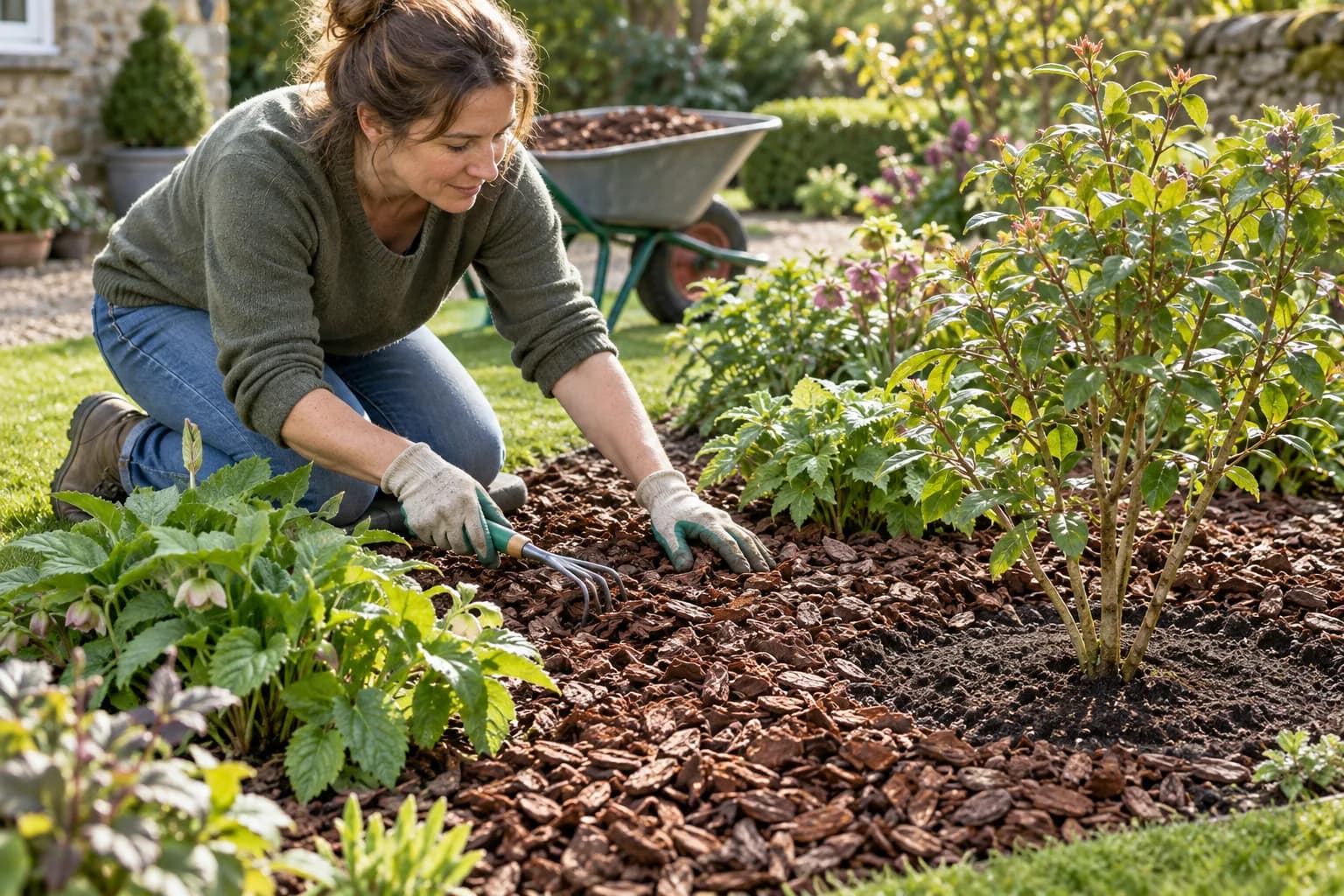
Two bags of mulch can look much the same on a shop shelf and do quite different jobs in the garden. Bark gives a lasting surface around shrubs. Compost suits a bed you keep planting. Gravel does not rot away, which becomes a drawback if you later want it gone.
Choose the material around the plants and the way you use the bed. Then check what is already on the soil before ordering more. The useful question is how much suitable coverage the bed needs, rather than how many bags make it look freshly finished.
1. Decide what the mulch should do
Mulch is a covering on the soil surface. It can help limit weeds and moisture loss, but choosing it involves more than picking a colour. Think about whether you want to improve the soil over time, how often you will change the planting and how you will maintain the finish.
Imagine one border with established shrubs at the back and a strip of seasonal flowers along the front. You might want a durable woody covering under the shrubs while keeping the front easy to replant. There is no need to give every part of the garden the same treatment.
Write down your main priority before shopping: fewer exposed patches, easier weeding, a surface around trees, or a finish for a dry gravel garden. If you are deciding how much planted space to create, first read the guide to balancing beds and lawn. Mulch is a finishing and care choice within that layout.
In Canadian gardens with a long frozen season, and in colder US regions, avoid copying a UK month-by-month schedule without adjustment. Iowa State’s mulch guidance notes that early application can slow spring soil warming. Use the condition of your bed and local advice to decide the timing.
2. Compare bark, wood chips, compost and gravel
| Material | A useful fit | Trade-off to consider |
|---|---|---|
| Bark | Established shrubs and perennial borders | Particle sizes vary; ask what the product contains and how it will look. |
| Wood chips | Trees and woody landscape planting | Mixed arborist chips have a less uniform finish than a selected bark product. |
| Mature compost | Beds where soil improvement and replanting matter | Breaks down; is less effective against weeds than some other mulches. |
| Gravel | Rock gardens and planting suited to a mineral surface | Does not add organic matter, and complicates later digging or removal. |
Bark or wood chips?
Bark is the outer covering of a tree; arborist chips are made from chipped tree and shrub material. Look at a sample of the actual product, especially before a bulk delivery. A photograph of fine, dark bark does not tell you what a mixed load of coarse chips will look like beside your path. Check particle size as well as colour.
For fresh wood chips, the planting matters. University of Maryland Extension accepts them on the surface around trees and shrubs, without mixing them into the soil. The RHS advises storing freshly chipped material for a few weeks before use. Keep woody mulch on the surface, and get advice specific to the planting before using fresh chips elsewhere. Fresh chips do not automatically mean you need extra fertiliser.
Compost or gravel?
Here, compost means mature garden compost, rather than a bag of potting mix sometimes called compost in the UK. Iowa State describes it as useful for improving soil but less effective at suppressing weeds than other mulches. Decide whether that trade-off suits a bed you work in regularly.
Gravel gives a durable surface, but durability is a commitment. Think through lifting plants, adding new ones and collecting fallen leaves. Unlike decomposing organic mulch, gravel does not add organic matter to the soil, and weeds can still establish in debris on top. Choose it because the planting and maintenance plan suit it.
3. Prepare the bed, then leave plants breathing space
Deal with existing weeds before covering the ground. Lay out any planting changes first, and move irrigation lines or labels into their intended positions. Taking a photograph before you cover the surface is a useful way to record what sits underneath.
The RHS recommends applying mulch over moist, unfrozen soil. Check the ground itself rather than judging from a damp-looking surface. If the bed stays waterlogged, investigate that separately using the garden drainage guide; covering the surface does not establish that the drainage is adequate.
Spread the material evenly and pull it back from trunks, stems and low-growing plants. You should be able to see where a shrub emerges from the ground. A heap climbing the trunk is not extra protection: Maryland’s excess mulch guidance explains the problems caused by deep layers and buried plant bases.
Discuss any proposed fabric layer before installation. Iowa State notes that organic debris can collect above fabric and support weeds, and that using it under organic mulch can interfere with the benefit to the soil. Ask what job the fabric is meant to do and what future planting or removal would involve.
4. Check the material and the existing depth
There is no single correct thickness for bark, compost and gravel in every garden. Published recommendations refer to particular materials and uses:
- UK beds and borders: the RHS gives 5–7.5 cm, approximately 2–3 inches, for biodegradable mulch.
- US trees and shrubs: Maryland Extension lists 1–3 inches, approximately 2.5–7.5 cm, for bark and wood chips.
- Different materials in that Maryland guide: compost and stone have separate recommendations of about 1 inch, approximately 2.5 cm.
The difference between these ranges is a reason to check the material and use, rather than average the numbers. Confirm a suitable finished depth using the product instructions and local horticultural advice, particularly for shallow-rooted or low-growing plants.
Then pull the existing mulch aside and measure what remains. In the shrub border, if the agreed finished covering is 5 cm and an even 3 cm of usable material remains, the top-up is about 2 cm. Another full 5 cm would leave an 8 cm layer. Check several places: an edge that looks thin may not represent the middle of the bed.
Before approving a top-up, also ask whether the existing material is suitable to retain. “Fresh mulch over everything” is an incomplete instruction if there are buried crowns, weeds or very deep patches to correct.
5. Work out the volume before comparing bags
Use the area to be covered and the additional depth needed. Both must use compatible units. For a simple rectangle, volume is length × width × depth. Measure separate sections for an irregular border and combine their areas, leaving out areas you will not cover.
The mulch, soil and gravel calculator handles metres, centimetres and litres, including a chosen allowance and whole bags. US readers with measurements in feet and inches will need to convert them before using that tool.
Compare supplier pack sizes before comparing bag prices. Ask whether a bulk quote is for volume or weight; they are different measurements, and the relationship varies with the material and moisture. Also check where the delivery ends. A load at the kerb still needs a route into the garden.
6. Plan the upkeep and make the quote specific
Check the bed before each proposed refresh. Look for bare areas, accumulated depth, weeds and material pushed against stems. Decide which patches need attention rather than replenishing the whole border simply because another year has passed.
For our mixed border, write down which material belongs under the shrubs and which belongs around the seasonal planting. Keep the product name and a photograph with the garden notes. That makes a later top-up easier to specify, whether you do it yourself or hire someone.
If you want help, ask every company to price the same points:
- weed removal and any correction of the existing layer;
- the named material, covered area and finished depth;
- the quantity supplied and treatment of surplus material;
- delivery, carrying access, spreading and cleanup;
- care around plants and instructions for future top-ups.
A quote for twelve bags delivered and a quote for a prepared, evenly mulched border describe different services. Once those details are clear, you can compare the price against the work you actually want done.
Sources and updates
Sources checked . Regional guidance is identified in the article.