

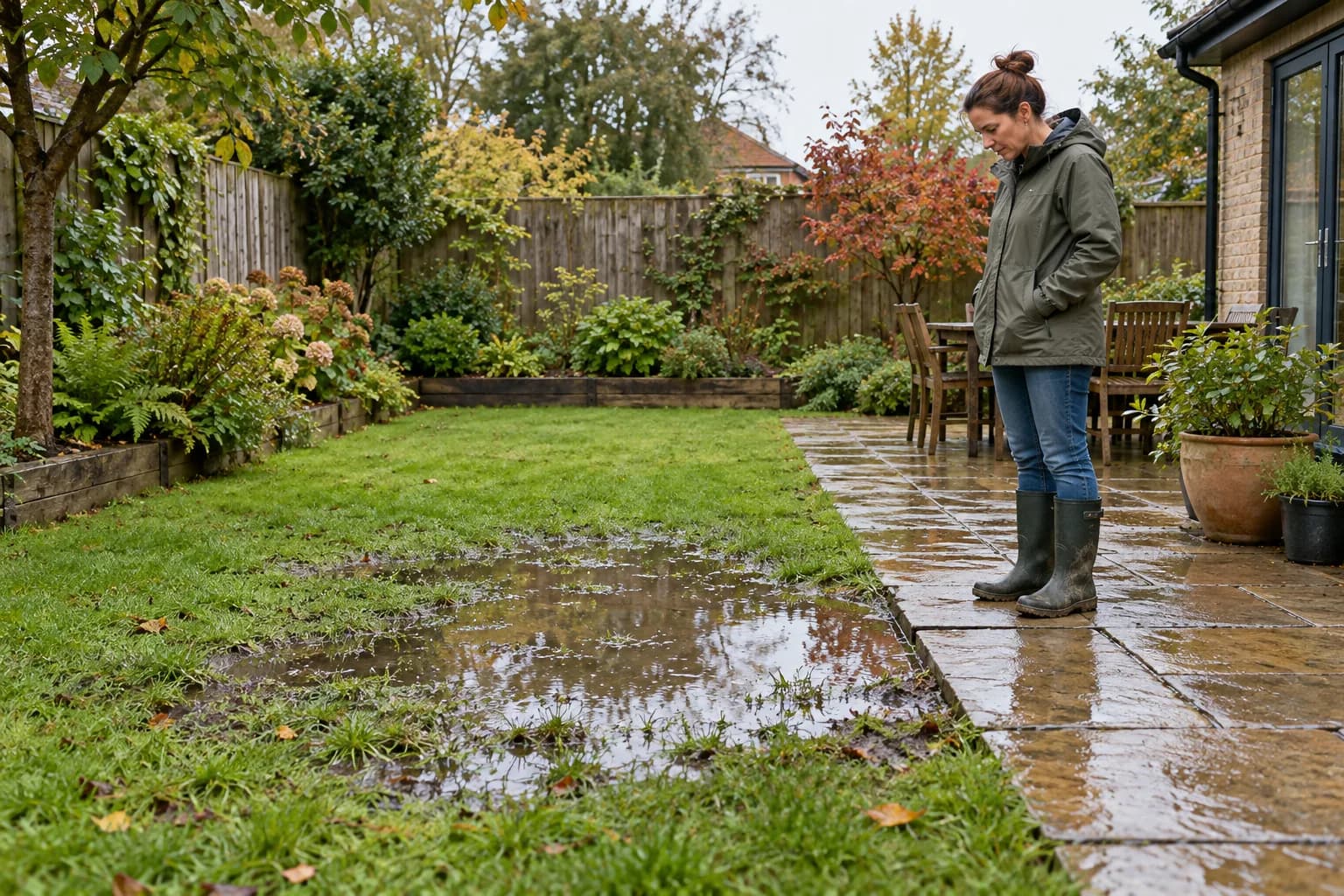
The rain stops, the patio dries, and the same patch of lawn is still squelching under your shoes. It is tempting to order a drain and be done with it. First, work out what is feeding that patch and where the water could go.
A garden drainage problem can begin at the surface, in compacted soil or deeper underground. The repair that suits one cause may do little for another. This guide helps you collect useful evidence and compare proposals before anyone starts digging.
1. Watch the water before changing the garden
Use the next rainfall to observe from a dry path or window. Where does water appear first? Does it spill from a downpipe, run off paving, arrive from higher ground or gather slowly across the lawn? Take a wide photograph that includes the house, boundaries and wet patch. A close-up of a puddle gives much less context.
Return to the same viewpoint after the shower and the following day. Record whether the patch is shrinking, whether other areas are drying and whether the soil stays soft between storms. A sequence of photographs is more useful than a single “before” shot. Include the date and whether the rainfall was a brief shower or a prolonged downpour.
Also note when the problem began. A wet corner after a patio extension raises different questions from a lawn that has struggled every winter. Recent vehicle traffic, a new shed, changes next door or a damaged drain are useful details to mention.
In colder parts of the US and Canada, record snowmelt and frozen-ground conditions separately from summer rain. Keep off saturated lawn where possible: the RHS waterlogging guide explains that walking on wet soil can make surface damage worse. If water is entering a building, arrange help for that problem first rather than waiting to redesign the garden.
2. Separate water arriving from water struggling to leave
Runoff is water moving across a surface. A roof or paved area can send it towards a garden bed faster than the ground there can absorb it. In this case, investigating the route and source matters as much as investigating the puddle.
A low spot collects water from the surrounding ground. Picture a shallow bowl in the lawn beside a patio: water may be flowing into it even when the rest of the soil drains reasonably well. Changing levels affects that flow, so any proposal needs to explain what happens beyond the repaired patch.
Compaction and slow-draining soil affect movement through the ground. Heavy traffic or construction can compact soil; clay-rich ground may drain slowly without having been damaged. The RHS identifies both among common causes of lawn waterlogging. A site assessment should distinguish them before recommending soil work.
Water below the surface or a leak needs another line of investigation. The RHS drainage guide notes that springs and broken pipes can create wet spots. If a patch stays wet during otherwise dry weather, tell the professional. Do not assume that every persistent puddle is simply clay.
3. Use the clues to ask better questions
Several causes can overlap. Treat these observations as prompts for an assessment, rather than a diagnosis made from a photograph.
| Clue | Possible explanation | Next check |
|---|---|---|
| Water runs from paving into one bed | Concentrated surface runoff | Trace the route and assess the paving levels and water source. |
| A hollow stays wet while nearby lawn dries | A low spot, possibly combined with slow infiltration | Check relative levels and the ground beneath the hollow. |
| A heavily used route is wet and worn | Compaction may be contributing | Assess soil structure and traffic before choosing treatment. |
| Much of the garden stays wet | Broader soil or groundwater conditions | Ask for a site-wide assessment and a feasible water destination. |
| One patch remains wet in dry weather | A leak or another continuing water source | Investigate the source before landscaping over it. |
For the bowl beside the patio, ask: “Is this mainly water arriving from the slabs, a depression in the lawn, or poor movement through the soil?” The answer should determine the proposal. If a contractor suggests a French drain, ask which of those problems it would address and where it would send the collected water.
4. Match the option to the problem
Aeration: when compaction is part of the cause
Aeration opens holes in the soil and can help a compacted lawn. The RHS advises waiting until standing water has drained before doing this work. Ask what condition the contractor has identified and what improvement they expect. Aeration does not redirect incoming roof runoff or create an outlet where none exists.
Changing levels: when surface water follows the wrong route
Regrading means reshaping the ground. Ask for the intended finished levels, where water will travel and how the work relates to doors, buildings, boundaries and existing planting. Get the restoration of disturbed lawn or paving included in the quote. For our patio-side hollow, filling it without checking the surrounding levels could simply move the puddle.
Drains: when collection and discharge both make sense
A surface channel catches runoff; a perforated underground drain collects water from the surrounding soil. Either system may use buried pipes to carry the collected water away. Ask what the proposed system will collect and how it reaches its destination. The RHS drainage guide stresses that surplus water needs somewhere suitable to go.
That destination might involve infiltration or a permitted outlet, depending on the site. Ask who checks ground suitability, underground services and local discharge requirements. Rules differ across US municipalities, Canadian provinces and municipalities, and the UK; a connection allowed at another property is not evidence that yours is allowed.
Rain gardens: when runoff can soak in on site
A rain garden is a planted depression designed to receive runoff and drain afterwards. It is not just the wettest corner filled with thirsty plants. The US EPA introduces rain gardens as a way to manage runoff from roofs and hard surfaces.
Site suitability still matters. The RHS guidance calls for reasonably well-drained ground. In Ontario, TRCA’s planning guide considers location, foundations, slopes and overflow. A design should show where surplus water goes when the garden fills. Use guidance for your area to assess the location and size, including distances from buildings.
5. Be wary of a repair that only hides the puddle
Gravel is not an outlet. Before covering a wet area, ask how the water below it will move. A dry-looking finish does not demonstrate that the underlying problem has been addressed.
Extra soil changes levels. Ask what adding it would do to nearby roots, paths, thresholds and water flow. Include those consequences in the assessment rather than treating a delivery of topsoil as a complete drainage plan.
New turf needs the cause resolved too. Replacing damaged grass may be part of reinstatement, but ask what will stop the same conditions returning. If the solution includes a drain, request an explanation of access for maintenance and what happens when the system is overwhelmed.
There may be a reasonable case for adapting a persistently damp area instead of draining it. Discuss wet-tolerant planting or a different use for that space. This choice still needs to account for buildings and neighbouring land; attractive planting does not make an unresolved flooding problem disappear.
6. Send a brief that helps someone assess the cause
Bring your observations together before contacting a company. You do not need to specify a pipe layout. You need to explain what is happening and what you want to use the space for.
- The pattern: when water appears, where it arrives and how the patch changes afterwards.
- The evidence: wide photographs, a simple sketch, approximate dimensions and recent changes.
- The constraints: access, structures, mature plants and known underground services.
- The outcome: usable lawn, a dry route to the shed or protection for an affected building.
- The proposal: assessment, water destination, permissions, excavation, disposal, reinstatement and maintenance.
Use the garden project brief builder to organise the message. If the work includes paving, the patio quote checklist helps you compare the preparation and drainage responsibilities too.
Then compare explanations as well as prices. A useful proposal tells you what the contractor found, why the suggested work fits, and what remains uncertain until further investigation. For the patio-side hollow, you should be able to trace the proposed route from the place water collects to the place it can safely go. That is a clearer basis for agreeing the work than a line item reading “install garden drainage”.
Sources and updates
Sources checked . Regional guidance is identified in the article.