

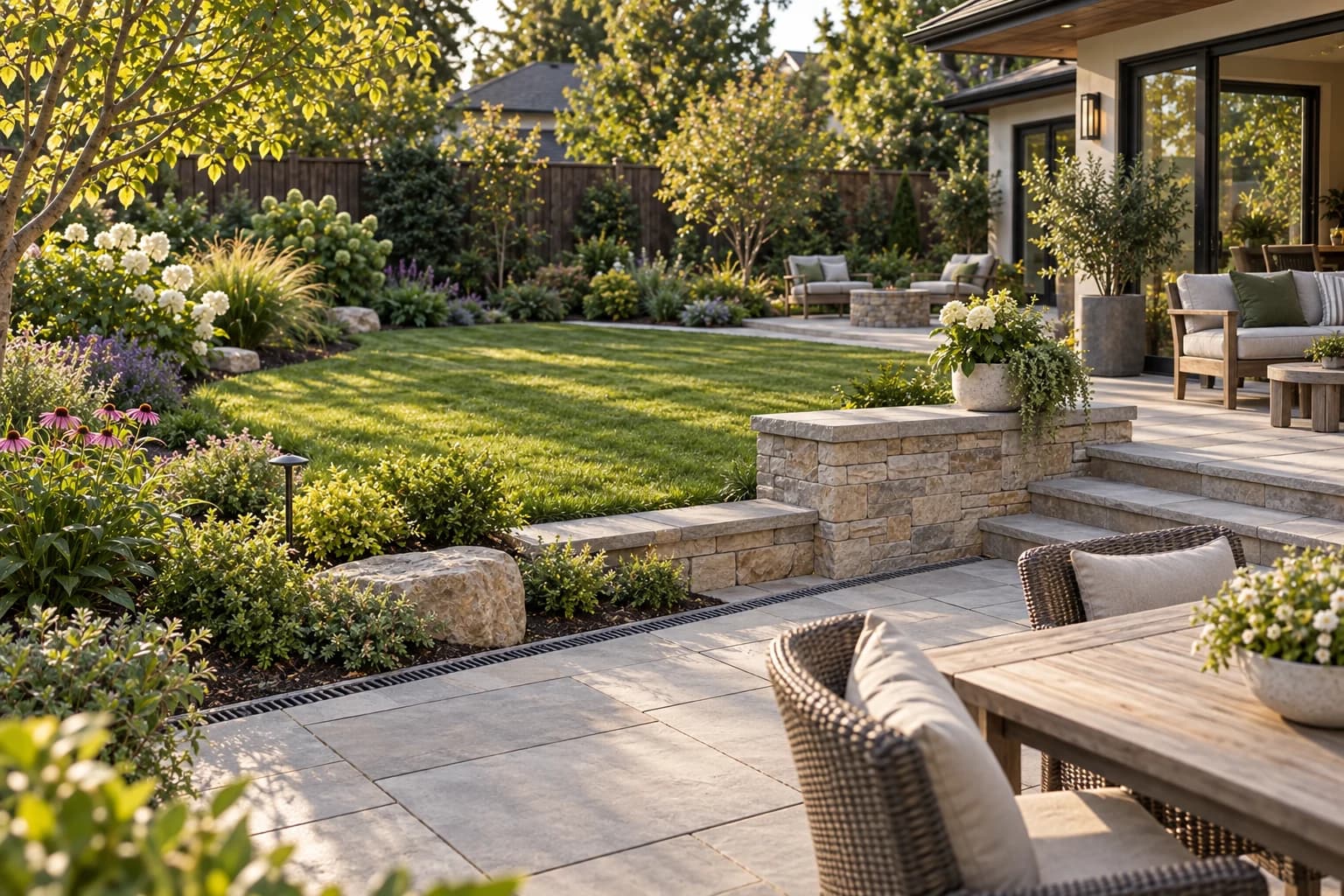
A crew that mows lawns every Friday and a contractor excavating for a stone retaining wall may both call themselves landscapers. One arrives with mowers and trimmers; the other may bring a compact excavator, drainage pipe, and a masonry crew. The label is broad, so the work behind it matters far more than the name on the truck.
The easiest way to choose well is to separate your project into three questions: Are you caring for something that already exists, changing the living parts of the yard, or building a permanent feature? A patchy lawn, an empty planting bed, and a leaning wall are three different problems—and usually three different scopes of work.
1. What Is Landscaping?
Landscaping is the planning, installation, or care of an outdoor space. It can involve softscape—soil, lawns, trees, shrubs, and other living material—as well as hardscape, the built elements that organize and support the yard. A backyard renovation that replaces turf, moves a path, adds privacy planting, and corrects standing water is landscaping because those parts must work as one system.
So, what does a landscaper do? The answer depends on the company. A small crew may focus on planting and seasonal cleanup. A landscape contractor may coordinate excavation, grading, drainage, irrigation, planting, and paving. A design-build company may take a project from the first sketch through construction and return later for maintenance.
Typical landscaping services include:
- creating or renovating planting beds;
- installing sod, trees, shrubs, mulch, or irrigation;
- grading soil and directing water away from problem areas;
- building patios, walkways, steps, walls, or lighting systems;
- planning a complete front-yard or backyard layout;
- maintaining the finished landscape through the seasons.
Think of landscaping as the umbrella, not a guarantee of every skill beneath it. Before assuming that a company can build a wall, diagnose a sick lawn, or produce a construction-ready design, look for that exact service and ask to see comparable work—not just attractive photographs of finished gardens.
2. What Is Lawn Care?
Lawn care concentrates on turf: how it looks, grows, and responds to soil, water, weeds, pests, disease, and regular use. The goal is usually to improve or preserve the lawn already there, through recurring visits or seasonal treatments, rather than redesign the yard.
Depending on the provider, lawn care services may include:
- mowing, edging, and blowing hard surfaces clean;
- fertilization and weed-control programs;
- aeration, dethatching, and overseeding;
- soil testing or pH correction;
- diagnosis and treatment of turf pests or disease;
- seasonal lawn cleanup and irrigation checks.
Service menus vary. A mowing company may not apply fertilizer or pesticides; those treatments can require separate training, certification, or licensing depending on the location. Likewise, a lawn care crew may repair a thin patch but not regrade a waterlogged yard or install a complete sprinkler system.
If the main issue is the condition of the grass—bare patches, weeds, poor color, or uneven growth—start with a lawn care provider. If water pools in the same low spot after every storm, new seed alone will not solve the cause; you probably need broader yard landscaping, grading, or drainage expertise.
3. What Is Hardscaping?
Hardscaping covers the non-living, constructed parts of a landscape. These features create circulation, seating, level changes, boundaries, and structure. Common hardscaping services include patios, walkways, driveways, garden steps, edging, retaining walls, gravel areas, decks, and masonry features.
The visible stone or paver is only the top layer of the job. A durable patio depends on excavation, a suitable base, compaction, edge restraint, drainage, and careful transitions to doors, lawns, and planting beds. A retaining wall may also require engineering, reinforcement, drainage behind the wall, and a permit. When a patio settles or a wall leans, the failure often began underneath—which is why a general maintenance crew is not automatically qualified to take on hardscape construction.
A hardscape contractor is a strong starting point when the project is mainly built from pavers, stone, concrete, timber, or block. For a project that mixes a patio with grading, lighting, irrigation, and planting, look for a landscape contractor with demonstrated hardscape experience or a team that coordinates the relevant trades.
4. What Is Landscape Design?
Landscape design answers the expensive questions before construction begins: Where should people walk and sit? Which views need screening? Where will rainwater go? What will the planting look like in three years, not just on installation day? A landscape designer turns those needs and site conditions into a coherent layout before materials arrive or excavation begins.
For a modest garden, that may be a scaled concept plan and a plant list. A larger or more technical project may need:
- site measurements and analysis of sun, soil, access, views, and existing features;
- concept options for circulation, seating, play, privacy, and planting;
- material selections, planting plans, lighting layouts, or irrigation zones;
- grading and drainage intent;
- construction details and documents that contractors can price.
Hire a landscape designer when the difficulty is not just doing the work, but deciding what the yard should become. A plan is particularly useful when several contractors need to price the same idea: without one, each may be quoting a different patio size, plant quantity, or drainage solution. Ask exactly which drawings and revisions are included and whether the designer also manages installation. For complex grading, engineered structures, public-safety issues, or work that requires stamped plans, local rules may call for a landscape architect, engineer, or another licensed professional.
5. What Is Landscape Maintenance?
Landscape maintenance protects an established outdoor space after it has been built or planted. It is broader than lawn care because the crew may look after beds, shrubs, small trees, irrigation, mulch, and seasonal appearance as well as turf.
A maintenance visit might include mowing, pruning, deadheading, weeding, checking irrigation, refreshing bed edges, clearing leaves, and noticing signs of plant stress before they become expensive losses. Other tasks—large-tree pruning, pesticide application, irrigation repair, or specialist plant care—may be handled by a qualified subcontractor.
The distinction matters when requesting a quote. “Monthly landscape maintenance” could mean little more than mow-and-blow service, or it could include detailed bed care and seasonal pruning. Ask for the visit frequency, task list, seasonal schedule, disposal terms, and exclusions in writing.
6. Landscaping vs. Lawn Care: Key Differences
The simplest difference between landscaping and lawn care is scope. Lawn care is about the turf. Landscaping can change or manage the whole outdoor space. If you can describe the job without mentioning anything beyond grass, lawn care is likely the closer fit.
| Professional or service | Typical work | Project pattern | Call when... |
|---|---|---|---|
| Lawn care provider | Mowing, edging, aeration, overseeding, turf feeding, weed or disease programs | Recurring visits or seasonal treatments | The grass is long, thin, patchy, weedy, or unhealthy |
| Landscape maintenance crew | Lawn plus beds, pruning, mulch, leaves, irrigation checks, seasonal cleanup | Recurring care across the property | The existing yard needs regular upkeep beyond turf |
| Landscaper or landscape contractor | Planting, sod, irrigation, grading, drainage, renovation, and sometimes hardscape | One-time installation or multi-stage project | You want to change how the yard looks, drains, or functions |
| Hardscape contractor | Patios, walkways, steps, walls, stonework, pavers, and base preparation | One-time construction | The main result is a permanent built feature |
| Landscape designer | Site analysis, layouts, material choices, planting plans, and project documents | Planning before installation | You need to solve the layout before requesting construction prices |
There is real overlap. A landscaping company may run a lawn care division, and a lawn company may install sod or maintain beds. That is not a problem as long as the proposal names the work, frequency, materials, exclusions, and person responsible. Compare that written scope, not the business name.
7. Landscaping vs. Hardscaping: Key Differences
Hardscaping is usually one part of landscaping. The difference is similar to “home renovation” versus “tile installation”: one describes the wider project, while the other identifies a particular construction specialty.
Soft landscaping changes the living side of the yard—soil, turf, and plants. Hardscaping changes the built side—paths, patios, steps, and walls. Successful projects make the two work together. A new patio sends runoff somewhere. A retaining wall changes soil depth and drainage. A shrub planted too close to a path may block it once mature. These are small details on a drawing and recurring annoyances in a finished yard.
For a standalone paver walkway, a hardscape specialist may be all you need. For a backyard renovation with a patio, lawn, planting, drainage, and lighting, choose a landscape contractor or design-build team that can coordinate the interfaces. Ask one party to take clear responsibility for finished grades and water movement; gaps between scopes often appear there.
8. Which Professional Do You Need?
Start with the result you can point to, not the job title you think you need. A clear sentence about the problem is more useful than saying you need “some landscaping”:
- “Keep the lawn neat every week.” Contact a mowing or lawn maintenance service.
- “The lawn is thin and full of weeds.” Look for a lawn care provider that diagnoses turf and offers the appropriate treatment program.
- “Replace the lawn and add planting beds.” Contact a landscaper experienced in sod installation, soil preparation, garden planting, and irrigation.
- “Build a patio or walkway.” Shortlist hardscape or landscape contractors with recent examples using the same material.
- “Stop the slope from washing away.” Look for drainage, grading, and retaining-wall experience; engineering or permits may also be needed.
- “We know the problems but not the layout.” Begin with a landscape designer before asking contractors to price construction.
- “Redo the entire backyard.” Look for a landscape design-build company or a designer and contractor who already have a clear way of working together.
- “Keep the finished garden healthy.” Choose landscape maintenance with a task list that covers both lawn and planting.
If a project includes a large tree, pool, electrical work, major drainage, structural wall, or significant level change, ask whether an arborist, pool contractor, electrician, engineer, landscape architect, or other locally qualified professional should be involved.
9. Can One Landscaping Company Handle Everything?
Yes—some companies design, build, and maintain complete landscapes. One accountable team can simplify scheduling and reduce the familiar “that belongs to the other contractor” problem where paving meets drainage, irrigation, soil, and plants. But “full service” is a claim to verify, not a universal standard.
Ask which work is completed by employees and which is subcontracted. Then request examples that match each major part of your project. A company may produce excellent planting plans but use a specialist mason for walls, or maintain lawns in-house while referring design work elsewhere. That arrangement can work well when responsibilities, supervision, insurance, and warranties are clear.
For a smaller project, a specialist is often more efficient. There is little value in hiring a full design-build firm to mow a straightforward lawn. For a complex renovation, however, stitching together the cheapest patio, irrigation, and planting quotes can leave nobody responsible when finished levels conflict or water flows the wrong way.
10. Questions to Ask Before Contacting a Company
A useful first message gives the company enough information to decide whether the project fits. “We have a roughly 20-by-30-foot backyard with narrow side access; we want to replace the failing lawn, add a small patio, and fix water collecting by the back door” will get a more useful response than “How much for landscaping?” Add your location, photographs, preferred timing, and any plan you already have.
Then ask:
- Do you regularly complete this exact type of work?
- Can you show recent projects with a similar size, site condition, and material?
- Will you assess drainage, grading, soil, and access before quoting?
- Who creates the design, and what drawings or specifications are included?
- Which parts are performed by your team, and which are subcontracted?
- What licenses, insurance, permits, or specialist qualifications apply locally?
- Does the written quote include preparation, materials, labor, equipment, disposal, cleanup, and restoration?
- How will changes to price or scope be approved?
- What maintenance will the new lawn, plants, or hardscape require?
- What workmanship, material, and plant warranties are included?
These questions reveal more than asking, “Do you do landscaping?” For a fuller hiring process, use Greendexo’s 12-question landscaper checklist. If you are still setting a budget, review the 2026 landscaping cost guide before comparing proposals.
11. Find the Right Landscaping Service Near You
Greendexo landscaping profiles can list 16 service categories, from lawn care, garden planting, sod installation, mulching, and seasonal yard cleanup to hardscaping, fencing, pressure washing, landscape lighting, and drainage and grading. Profiles may also identify landscape design, irrigation, trimming, patios and walkways, retaining walls, and artificial turf services. Those labels let you narrow the field before making calls, especially when your project combines two or three specialties.
First, review the full Greendexo landscaping service directory to see how companies describe their work. Then use the landscaper map to find companies near you. Open individual profiles and look for the combination that matches your brief: for example, landscape design plus hardscaping for a new layout and patio, or lawn care plus seasonal cleanup for ongoing upkeep.
A profile is a starting point, not a substitute for due diligence. Confirm that the business currently offers the service, has relevant experience, is available in your area, and carries the insurance, licenses, or specialist credentials required for the work. For a mixed project, send every shortlisted company the same scope so you can compare like with like.
Plan this job and find a matching provider
Patio installers serving Belfast, then calculate mulch, soil or gravel volume. Coverage and capabilities are directory declarations; confirm your particular job directly.