

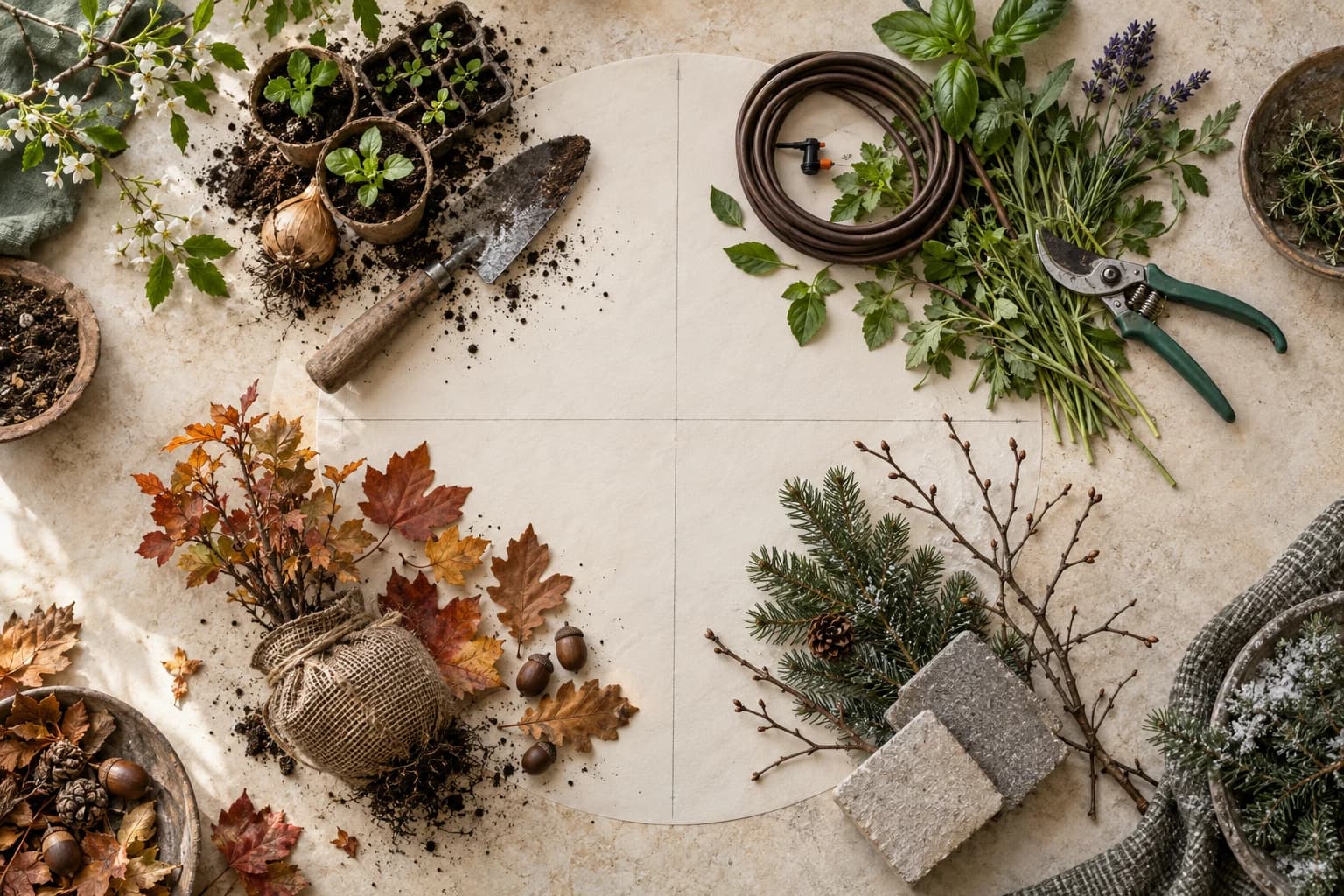
The first warm weekend of spring can make every unfinished corner of a yard feel urgent. But a date that suits planting may be a poor one for excavation, and a dry week that is perfect for building a patio may be too hot for establishing a hedge.
The best time for landscaping is the point where the work, the site, and the local climate line up. New grass needs suitable soil temperatures and dependable moisture. A patio needs stable, workable ground. A tree needs time to begin establishing without immediately facing drought or a hard freeze. Treat the seasons below as planning windows—not fixed dates—and let current conditions and local knowledge settle the final schedule.
1. Is There a Best Time of Year for Landscaping?
For a mixed project, the useful answer is usually a sequence rather than a season. Fix drainage and grades before laying a patio. Put irrigation or lighting sleeves beneath paths before they are paved. Bring in trees before narrow access routes are closed, then install the lawn near the end so machinery does not churn it up. Good sequencing can matter as much as good weather.
This quick landscaping calendar shows the pattern, but every row has exceptions:
| Project | Often favorable | Main condition to check |
|---|---|---|
| Trees and shrubs | Cool, mild periods; often fall or spring | Soil must be workable, not frozen or waterlogged; the plant needs time and water to establish |
| Cool-season lawn | Late summer to early fall; spring can be a second window | Local turf type, soil temperature, irrigation, and time before frost or heat |
| Warm-season lawn | Late spring into summer | Active growth, warm soil, and adequate establishment water |
| Patios and paths | Any dry, workable period | Stable subgrade, material temperature limits, access, and rain |
| Drainage and grading | When the problem can be observed, but soil is dry enough to work | Outlet, permits, utilities, and avoiding compaction of saturated soil |
| Irrigation | Before planting or final surfaces; inspection in spring | Local watering rules and winterization requirements |
Let the weather veto the diary when necessary. Heavy equipment on saturated soil can leave deep ruts and compact the very root zone the project is meant to improve. Frozen ground, extreme heat, drought restrictions, storms, and temperature limits for concrete, mortar, adhesives, or sealers can all turn an otherwise sensible date into the wrong one.
2. Spring Landscaping Projects
Spring is when a landscape starts giving evidence. Snowmelt or repeated rain outlines low spots, blocked drains, eroding slopes, and downspouts that send water toward the house. Bud break reveals which plants survived winter, and the first irrigation test often exposes cracked fittings or misdirected heads. Cool weather can also provide a useful planting window—but only once the ground is ready.
Good spring landscaping work can include:
- site surveys, soil tests, measurements, and a full design;
- drainage diagnosis while water paths are visible;
- irrigation inspection, leak repair, and controller setup;
- planting suitable trees, shrubs, and perennials once soil is workable;
- bed preparation, edging, mulching, and cool-season lawn repair;
- hardscape work after the subgrade has dried enough for excavation and compaction.
The common mistake is confusing warm air with workable soil. Squeeze a handful from the intended work area: if it smears and holds as a sticky ball instead of breaking apart, excavation and machinery may damage its structure. Spring is also a peak inquiry period for many landscaping companies. A project first discussed in April may be designed in April, quoted in May, and built considerably later.
3. Summer Landscaping Projects
Long days and fewer rain interruptions can make summer productive for patios, paths, walls, lighting, fences, and other construction. It is also the active establishment period for many warm-season grasses. Yet summer means something very different in coastal Britain, the Pacific Northwest, Ontario, Georgia, or Arizona: it may be the easiest building window or the harshest planting window of the year.
Planting container-grown material in summer is possible, but it shifts more responsibility to aftercare. A new root ball occupies only a small volume of soil just as evaporation and water demand are rising. If the property will be empty for two weeks, irrigation is restricted, or nobody can check moisture below the surface, postponing a large planting scheme may be the more responsible choice.
For summer construction, ask how the crew will protect retained lawns and tree root zones, manage dust and heat, and secure exposed soil before a storm. A dry forecast helps excavation, but baked, compacted ground can be surprisingly difficult to grade. “Summer” is a season, not a guarantee of suitable site conditions.
4. Fall Landscaping Projects
Fall often offers the best balance in temperate climates: cooler air above ground, lingering warmth below it, and fewer days of punishing evaporation. That combination can make it an excellent window for trees, shrubs, perennials, spring-flowering bulbs, and cool-season lawns.
It is also a useful time to:
- renovate thin cool-season turf through aeration and overseeding;
- divide or relocate suitable perennials;
- add mulch after planting while keeping it away from trunks and stems;
- correct drainage before winter precipitation;
- finish hardscape work before repeated freeze-thaw cycles or prolonged wet weather;
- review the irrigation schedule as plant water demand falls.
That does not make fall universally safe. A tree installed late in a cold interior climate may have little time to settle before the ground freezes. Some broadleaf evergreens and conifers can lose moisture to winter wind while frozen soil prevents replacement water from reaching their roots. Warm-season turf, meanwhile, is heading toward dormancy. The colder the site and the later the date, the more the species—and the aftercare plan—matter.
5. Winter Landscaping Projects
A winter garden is easier to read than it looks. With foliage reduced, grade changes, drainage routes, weak structure, overlooked views, and gaps in screening become obvious. Photos taken after heavy rain or snowmelt can be more useful to a designer than a dozen midsummer snapshots. Winter is also a practical time to measure, develop the plan, compare materials, check permissions, request like-for-like quotes, and reserve a realistic build window.
Depending on the climate, winter may also suit dormant-season planting, bare-root hedging, arborist work, pruning of appropriate species, and hardscape construction. The limits are physical: excavation should not proceed through frozen or saturated subgrade merely to stay on schedule, and concrete, mortar, adhesives, sealers, and plants each have installation conditions that must be followed.
In a frost-free region, winter may be one of the easiest times for major work because heat stress is lower. In a snowbound region, it may be almost entirely a design, procurement, and booking season. A useful landscaping calendar begins with those local realities instead of treating winter as a universal shutdown.
6. Best Time to Plant Trees and Shrubs
The best time to plant trees and shrubs is usually a stretch of mild weather with workable soil and a credible watering plan. In much of the UK, the Royal Horticultural Society recommends October to April, while avoiding frozen or waterlogged ground. Container-grown plants can be planted at other times, but warm-weather planting demands more water and attention.
Do not copy that UK window onto every North American climate. A cold Canadian or northern US site may favor spring for some plants; fall can work well where roots still have time to establish before the ground freezes. In hot-summer regions, fall planting can spare a new plant from facing extreme heat immediately. Plant form matters too: bare-root and root-balled stock have much narrower dormant-season availability than container-grown stock.
Before choosing a date, check:
- the species and cultivar, including heat and cold tolerance;
- the local first- and last-frost pattern—not only the national hardiness zone;
- soil drainage, because a planting hole in saturated soil can remain oxygen-poor;
- whether reliable watering and follow-up visits are available;
- the plant’s mature size, overhead lines, underground utilities, and nearby structures.
Hardiness maps answer “might this plant survive here?” more readily than “should I plant it next Saturday?” The USDA map is based on average annual extreme minimum temperatures, while Canada’s system combines several climate variables. Neither can see the standing water beside your garage, the wind funnel between two buildings, or the dry spell in next week’s forecast.
7. Best Time to Install or Repair a Lawn
The answer to “when should I install sod?” begins with a less glamorous question: what grass is it? Cool-season grasses grow most actively in cooler spring and fall weather; warm-season grasses establish during late-spring and summer warmth. A national recommendation that ignores that distinction can send a homeowner to exactly the wrong month.
For a cool-season lawn, late summer into early fall is often the strongest seeding or renovation window: the soil is warm, air temperatures are moderating, and seedlings may face less competition than in spring. Spring can work if irrigation and weed pressure are managed. The University of Minnesota’s lawn calendar, for example, reflects its northern climate and lists sod windows in late spring to early summer and again from mid-August into fall.
For warm-season turf, establishment generally belongs in the active growing period. University of Georgia Extension guidance places the best seeding or sodding period for a new warm-season lawn from May through July in its region. Those months are an illustration, not a rule for Toronto, Vancouver, London, or every US state.
Sod is more flexible than seed because it arrives with roots and established cover, but it is not instant lawn in the practical sense. The base still needs correct grading and preparation; rolls must be laid promptly; seams and edges must not dry out; and water must be available from day one. A rushed installation on frozen, waterlogged, dusty-hard, or poorly prepared soil simply hides the problem beneath green turf.
8. Best Time for Hardscaping Projects
Patios, walkways, steps, retaining walls, and edging follow the condition of the ground more than the growth cycle of plants. A dry, stable site with workable soil is usually more valuable than the name of the season. That is why a mild winter can be productive in one region while spring remains too wet in another.
What sits below the finished surface is what makes hardscaping last. The schedule has to accommodate demolition, excavation, utility checks, drainage, sub-base installation, compaction, edge restraints, the surface itself, and any required curing. Rain can fill an excavation; saturated soil can deform under equipment; frost can prevent proper preparation; and extreme temperatures may fall outside a product’s installation instructions.
If planting is part of the same project, complete the heavy construction first whenever practical. Protect retained trees and soil, agree machinery routes, install sleeves for irrigation or lighting beneath new paving, and set finished levels for lawns and beds. The best hardscaping season is the one in which the entire build-up—not only the attractive top layer—can be installed correctly.
9. Best Time for Irrigation and Drainage Work
Plan irrigation before new lawn and planting—and before fresh paving closes off an easy pipe route. Spring is a natural time to inspect systems for winter damage. In freezing climates, the calendar also needs a shutdown and winterization date; the US EPA advises turning off the water supply and draining the system before freezing weather.
Once irrigation is running, avoid the “set it and forget it” approach. The EPA WaterSense program recommends seasonal adjustment instead of leaving a controller at peak-summer demand all year. New plants need close monitoring while their roots occupy a small area; the program can become less frequent and more efficient as they establish.
Drainage has an unusual timing split: diagnose it when the site is wet, build it when the soil is workable. During or just after rain, photograph ponding, trace runoff, and note whether water disappears in an hour or remains the next day. Installation should wait until equipment can work without smearing and compacting saturated soil. Before approving a trench or outlet, confirm where the water may legally and safely discharge; rules for storm drains, neighboring property, soakaways, and permits are local.
10. How Climate and Location Change the Landscaping Calendar
The United States, Canada, and the United Kingdom do not share one landscaping season. Neither do two properties in the same town. Elevation, distance from the coast, rainfall, urban heat, shade, soil, wind, and exposure can move the workable window by weeks.
- Cold continental climates: a short construction season, frozen soil, road restrictions, and early fall frost can compress the schedule. Spring may also stay saturated after snowmelt.
- Hot or arid climates: fall through spring may be better for planting and construction, while summer demands heat planning and dependable irrigation. Water restrictions may control what can be established.
- Warm, humid climates: warm-season turf and long planting seasons are possible, but intense rain, hurricanes, heat, disease pressure, and poor drainage can interrupt work.
- Maritime climates: mild temperatures can extend planting and construction, but waterlogged soil and repeated rainfall may be the main constraints.
- Local microclimates: a windy balcony, shaded clay backyard, south-facing wall, frost pocket, or exposed rural lot can behave differently from the nearest weather station.
Use the USDA Plant Hardiness Zone Map, Natural Resources Canada’s plant hardiness resources, or appropriate UK guidance to narrow the question—not to answer it alone. Then add advice from local extension services, councils or municipalities, water providers, nurseries, and landscapers who regularly work with the same soil and weather as your property.
11. When Should You Contact a Landscaper?
Contact landscaping companies before you expect tools on site. A modest cleanup may need little lead time; a redesigned backyard involving drainage, paving, planting, product selections, permits, and several trades may need months of decisions before excavation begins. Peak spring and early-summer calendars can fill while the ground is still cold.
A useful planning rhythm is:
- For spring work: begin conversations in fall or winter, especially if design or permits are involved.
- For fall planting or lawn work: contact companies in spring or early summer so plant sourcing and preparation are not rushed.
- For a large renovation: start as soon as the objectives and approximate budget are clear; let the design and approvals determine the build window.
- For drainage failures or unsafe trees: seek qualified advice promptly rather than waiting for the “ideal” landscaping season.
Availability is not the same as suitability. A clear proposal should explain why the dates fit the materials, plants, ground conditions, and aftercare plan—not simply state that a crew is free. If a company offers year-round installation, ask what rain, frost, heat, or soil conditions would make the team pause or reschedule. A credible answer is a good sign.
12. Planning Your Next Landscaping Project
Start with the life the space needs to support: a lawn that can handle children, a patio that sheds water away from the house, shade near an afternoon seating area, lower-maintenance beds, or a complete outdoor renovation. Then split the work into design, site preparation, construction, irrigation, planting, lawn, and establishment care. The sequence will reveal what is weather-sensitive and what can move ahead while you wait for the right installation window.
- Record the site. Photograph sun and shade at different times, slopes, access, utilities, existing plants, and water movement in both dry and wet weather.
- Set scope and priorities. Distinguish essentials from features that can form a later phase.
- Check local constraints. Review permissions, protected trees, utility marking, drainage rules, watering limits, and seasonal access.
- Build the schedule backward. Work from the season in which the finished space is needed, allowing for design, quotes, approvals, ordering, construction, planting, and several weeks or months of aftercare.
- Compare like with like. Give shortlisted companies the same brief and ask each one to explain its proposed timing.
The best plan is not the one that starts fastest; it is the one that gives each layer of the project a fair chance to succeed. Use the 12-question landscaper hiring guide to assess a shortlist and the 2026 landscaping cost guide to prepare a realistic budget. When you are ready to turn the calendar into a project, explore landscaping companies serving your area on the Greendexo map.
Sources and methodology
Seasonal sources reviewed 7 October 2026. The free planner covers UK gardens using the RHS calendar; Minnesota and Georgia examples below apply to their stated regions.
This guide gives general planning guidance for homeowners in the United States, Canada, and the United Kingdom. It deliberately avoids a single national planting calendar. Local weather, soil, species, regulations, product instructions, and professional assessment should set the final dates.
- USDA: 2023 Plant Hardiness Zone Map
- University of Minnesota Extension: Lawn care calendar
- University of Georgia Extension: Warm-season lawn timing
- RHS: Planting trees and shrubs
- RHS: Laying turf
- RHS: Spring garden tasks
- RHS: Summer garden tasks
- RHS: Autumn garden tasks
- RHS: Winter garden tasks
- Natural Resources Canada: Climate, frost, and plant hardiness maps
- US EPA WaterSense: Irrigation maintenance and seasonal adjustment
- Penn State Extension: Working soil and avoiding wet-soil compaction